In 2025, the Winnemem Wintu Tribe continued work to bring the Nur (salmon) home to the Winnemem Waywaket (McCloud River). We continued advocacy to rematriate the wild Nur from New Zealand and for the construction of a volitional fish passage around Shasta and Keswick dams so the Nur can swim freely from the mountains to the oceans and back. We also completed our fourth year of reintroducing Winter Run Chinook to the Winnemem Waywaket at wayelporhormas (AhDiNa campground).
We are grateful for the support of everyone who has prayed with us and stood with us over the years to bring the Nur back home. Our work is far from complete, and we’ll need continued prayers and support in 2026. Here are some of the highlights and challenges of our work this past year.
Employing Tribal Members as Cultural Resource Specialists
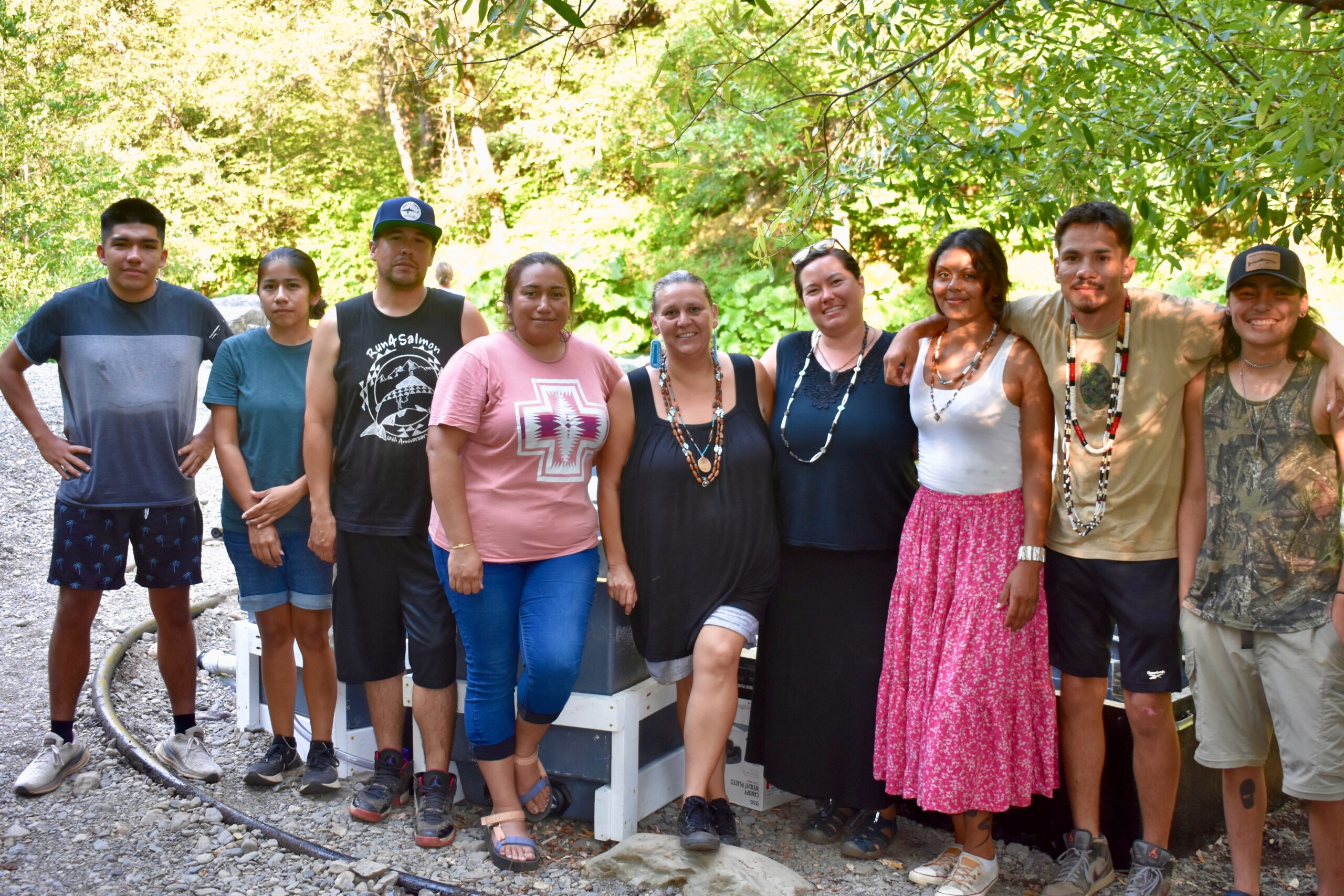
Through a grant with California Department of Fish and Wildlife (CDFW), the Winnemem Wintu Tribe has been able to employ Tribal members as Cultural Resource Specialists since 2023 to care for Winter Run Nur who are being hatched and raised in special riverside incubators and then reintroduced to the Winnemem Waywaket. The team also helps with ecological restoration projects in the watershed. In 2025, we welcomed new team members Nate Wilson, Cas Garcia, and Brandon Baker. The Cultural Resource Specialists are the heart of our salmon restoration work and spend every day on the river caring for the Nur eggs and safely trapping and moving them around Shasta Dam until a volitional fish passage can be built. Cultural Resource Specialists also tended to our homelands along the Winnemem Waywaket through invasive species removal, cultural burns, and native species propagation.
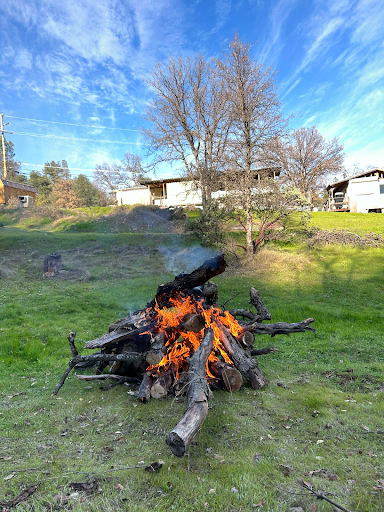
See the Nature-based Nur Incubation System in action!
Our team also contributed to improving trap designs in 2025. Lead Traditional Scientist Marine Sisk and Cultural Resource Specialist Supervisor Arron Sisk worked with CDFW and Pacific States to design a more fish friendly “incline plane trap” to capture the Nur moving downstream and move them around Shasta Dam. We are still improving designs to incorporate Traditional Ecological Knowledge and provide the safest environment for the Nur. In the 2025 season, 8,971 Nur were caught and moved to the Nomtipom Waywaket (Sacramento River) for the chance to swim to the ocean and back.
We have also worked with partners at the UC Davis Jeffries/Johnson Lab to create a “fish viewer” to photograph fish to determine their size and weight, which the Tribe has determined to be a less invasive fish measurement methodology than standard fisheries’ practices. The Tribe continues to advocate for wild Nur (which means minimal handling) and minimal human intervention in all fishery practices.
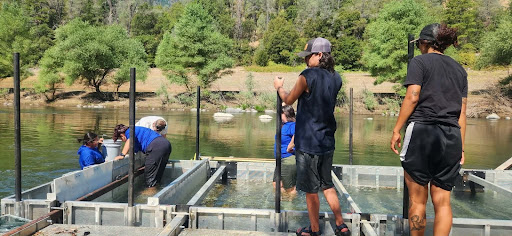
A Traditional Perspective on Adult Salmon in the Winnemem Waywaket
2025 was the first year in which McCloud-reared adult Nur returned. Two males who had been reared in the Winnemem Waywaket in 2023 made their way to the ocean and returned to the Nomtipom Waywaket, where they were caught near Livingston Stone National Fish Hatchery (LSNFH). It was a bittersweet milestone for the Winnemem Wintu, as we celebrate these first returns and also mourn the prevention of their return back to their spawning grounds. Federal and state agencies currently prevent the Winnemem Wintu from bringing adult salmon back above Shasta Dam due to concerns about pathogen risk and the lack of a water filtration system at Livingston Stone National Fish Hatchery. This is a high point of contention for the Winnemem Wintu, who only agreed to introduce Nur eggs into the Winnemem Waywaket with the understanding that they could return to their spawning grounds and complete a natural life cycle. We are asking agency partners to rectify this situation and have spurred the creation of working groups to facilitate the urgent construction of water treatment facilities at Livingston Stone National Fish Hatchery.
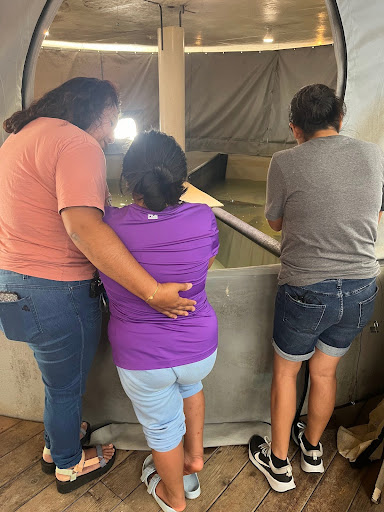
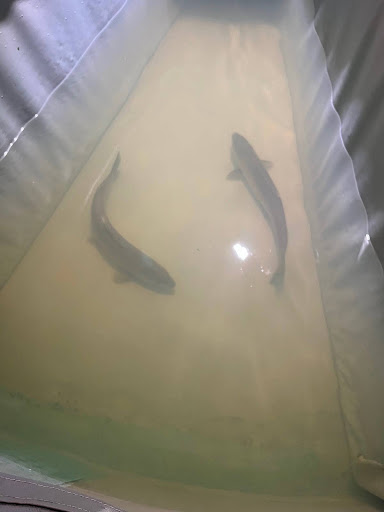
(Left) Marine Sisk, Mya Sisk, and Nina Sisk observe the two McCloud reared Nur. (Right) The two Nur swim in a tank at Livingston Stone National Fish Hatchery. They were not allowed to be transported above Shasta Dam. (Photo by Bekah Olstad)
In 2025, partners also shared reports of adult Nur in the Winnemem Waywaket potentially engaging in spawning behaviors. Videos of the Nur were shared widely on social media and picked up by local and national news outlets, who celebrated the presence of adult Nur as a restoration accomplishment. However, for the Winnemem Wintu, these reports were based on incomplete information and were a mischaracterization of our Indigenous Traditional Ecological Knowledge (ITEK). Our ITEK indicates that many juveniles who hatched in the Winnemem Waywaket will stay in the river for at least a year if not several years before attempting to migrate. If there were McCloud-reared Nur engaged in spawning behaviors, which has not been confirmed, this would represent a deviation from a natural life cycle as these adults have not been to the ocean and back.
As Chief Sisk says, “Salmon must complete a full life cycle to bring nutrients from the mountain to the ocean, and from the ocean to the mountain. There are no shortcuts. We cannot go against nature.” If Chinook salmon are going against their nature, this highlights an urgent need for volitional fish passage around Shasta and Keswick Dams, as Chinook salmon are categorically not “lake spawning” fish and must fulfill their original instructions and role in the ecosystem.
Innovations in Fisheries
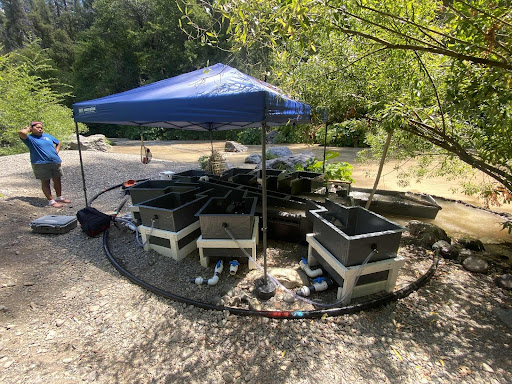
This past summer, for the third year, we utilized the innovative NUR Nature-based Incubation system, a more wild-like incubation system for rearing salmon eggs developed by Chief Sisk (patent pending). The alevins and fry have the opportunity to imprint to the natural rocks and plants of the river, practice swimming in a variety of currents and temperatures, and choose when to leave the tanks into the river. We thank the UC Davis Fish Conservation Physiology Lab for their partnership in realizing the NUR Nature Base. In 2025, 83,056 eggs were placed in the Nur Nature-based Incubation system, more than double from the previous year, and the results so far have been encouraging. The system and environment produce Nur who appear to be more resilient and stronger swimmers than fish raised using conventional hatchery practices.
Rematriation of Nur From New Zealand
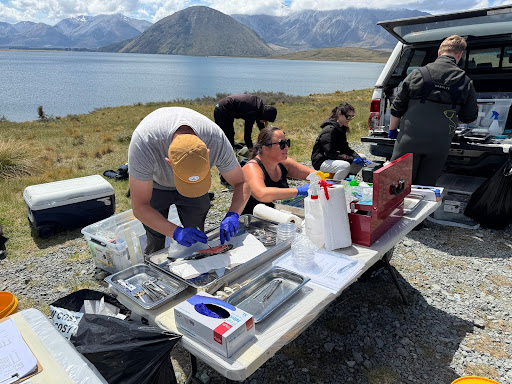
Last year we also continued the work to bring home our Nur from New Zealand. A team led by Dr. Melanie Cheung, including Central South Island Fish & Game (CSIFG) and Ngāi Tahu youth, had two successful seasons of catching Nur to be sampled for pathology testing, a requirement by state and federal agencies for rematriation to California. The operations required significant planning, coordination, and cost, and involved a team member carrying each day’s salmon samples on commercial flights from New Zealand to a Washington state pathogen testing laboratory. The Winnemem Wintu continue to negotiate with state and federal agencies to come up with a rematriation plan that will meet the needs of the Tribe and the ecosystem to maintain the wildness of the Nur, while also satisfying regulatory guidelines. Unfortunately, these negotiations have not resulted in a path that can be agreed upon by all parties. The Winnemem Wintu remain committed to finding a way for the Nur to come home and retain their wildness, knowing that only by remaining in their wild state will the species survive.
The Winnemem Wintu thank the Ngāi Tahu elders including Tewera King and Karl Russel, Dr. Melanie Cheung, CSIFG, the youth interns, and all who have supported the efforts to rematriate the Nur. The Winnemem Wintu were very pleased to welcome a Ngāi Tahu delegation to this year’s summer ceremony.
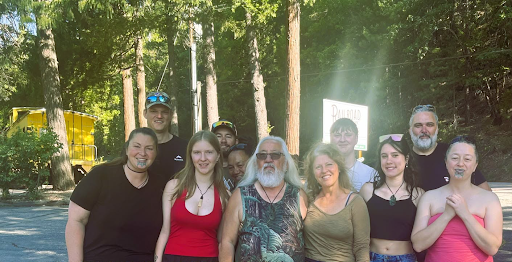
Building a Volitional Fish Passage Swimway
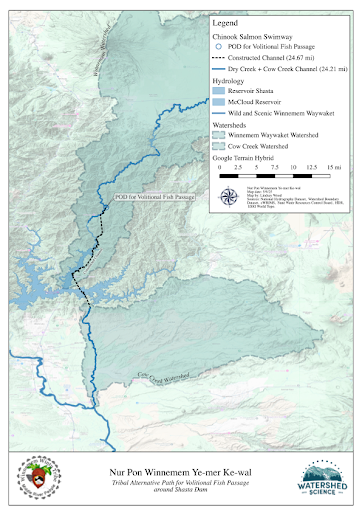
In 2025, studies and reports were carried out to evaluate fish passage options around Shasta and Keswick Dams. The Winnemem Wintu only support fish passage that is fully volitional (no human intervention such as truck and haul or fish cannons). Through ceremony, prayer, and traditional ecological knowledge of the watershed, the Nur have shown they will return and use the swimway path of Cow Creek, Little Cow Creek, Dry Creek, and around Shasta reservoir. This year the Winnemem Wintu Tribe worked with engineers and biologists to conceptualize a way to connect the top of Dry Creek to a pathway or constructed river channel that would go around Shasta reservoir and connect to the Winnemem Waywaket.
The Winnemem Wintu have been disappointed by studies that rank trap and haul options as viable long term solutions, as this ignores the Tribe’s traditional knowledge and the biological realities that trap and haul does not work to truly restore salmon runs in the long run. More funding and political support is needed to adequately study and develop the fish passage route the Winnemem Wintu are proposing. Political will is needed to acknowledge that Indigenous Traditional Ecological Knowledge should be the most important guiding factor in making decisions about the health of the Nur.
Next Steps
The Winnemem Wintu Tribe has been advocating for the return of the Nur since the fish were blocked from their homelands with the construction of the Shasta Dam. From the H’up Chonas (War Dance) in 2004 to the Run4Salmon prayer journey to the historic reintroduction of Winter run Chinook above Shasta Dam four years ago, we will always keep fighting for the Nur to come home for the sake of the water, the climate, the birds, bears, people and all who rely on this “keystone of keystone” species.
The Winnemem Wintu’s grant with CDFW will expire at the end of February 2026, and this will pose a significant loss for Tribal employment and the ability to carry out salmon restoration work. The Winnemem Wintu Tribe is seeking additional funding from the state and calling on political leaders to continue funding this work, to open a pathway for rematriation from New Zealand, and to invest in developing and planning the Tribe’s selected volitional fish passage route. There are no shortcuts, and we know that the Nur must be wild and allowed to swim freely from mountain to ocean and back for real salmon restoration to occur. We will continue to follow these sacred instructions.
Hii chala besken,
The Winnemem Wintu Nur Restoration Team